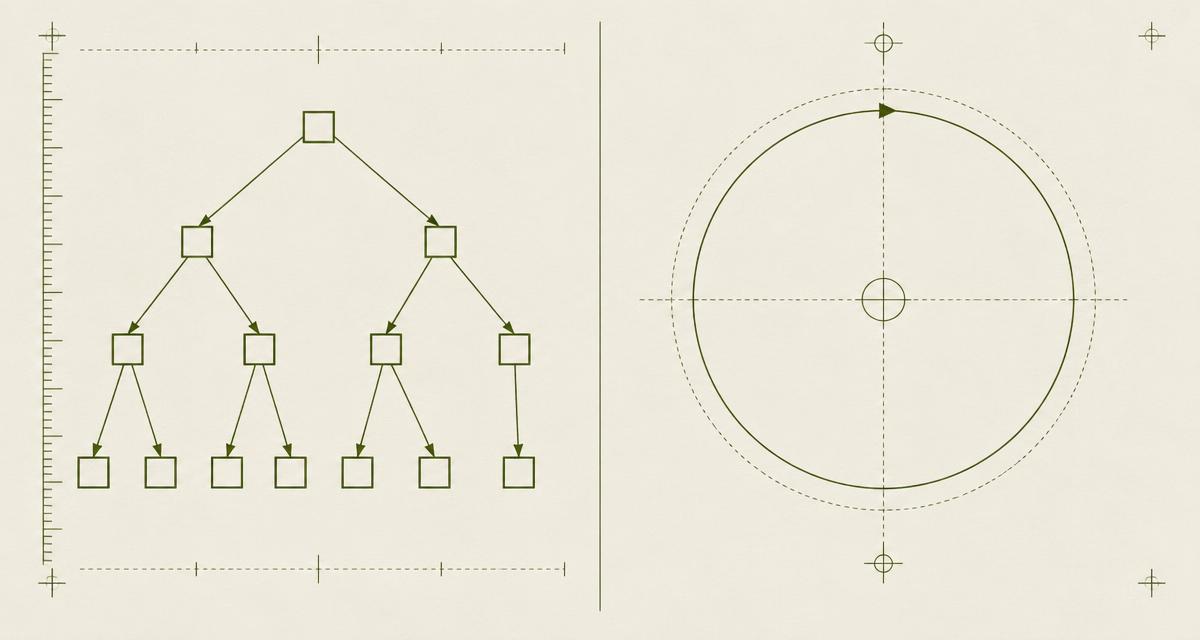
Graph Engineering vs. Loop Engineering in AI Agents
Explore the architectural trade-offs between graph and loop engineering when building AI Agents, including production realities and state management.
As organizations move beyond basic prompt engineering to deploy autonomous systems, the central architectural question for any Agentic AI Engineer becomes one of control. How much autonomy do you hand over to the large language model (LLM), and how much do you constrain its execution through predefined paths? This tension has given rise to two distinct but overlapping paradigms in the development of AI Agents: loop engineering and graph engineering. Choosing between them dictates how your systems handle state, recover from failures, and scale in production.
The Core Architectural Divide: Workflows vs. Agents
To understand the difference between graph and loop engineering, we must first define the spectrum of autonomy. According to Anthropic, the distinction lies in who directs the process [1]. Workflows are systems where LLMs and tools are orchestrated through predefined code paths. The system dictates the sequence of events, and the LLM is utilized at specific junctures to process information or generate text. Agents, conversely, are systems where the LLMs dynamically direct their own processes and tool usage, maintaining control over how they accomplish tasks [1].
Workflows offer predictability and consistency, making them ideal for well-defined tasks. AI Agents are better suited for scenarios requiring flexibility and model-driven decision-making at scale [1]. However, as frameworks have evolved, the line between these two concepts has blurred, leading to the specific engineering practices of loops and graphs.
Loop Engineering: The Model in the Driver's Seat
Loop engineering focuses on a core, iterative cycle driven by the LLM's reasoning capabilities. The OpenAI Agents SDK explicitly defines this "agent loop" as the foundational concept of their architecture [12]. The mechanics are straightforward: the system calls the model, inspects the output, and acts based on that output. If the model requests a tool call, the system executes the tool and feeds the result back into the model. If the model requests a handoff, the system switches to a different agent and continues. If the model provides a final answer without requiring further tool work, the loop terminates and returns the result [12].
In this paradigm, tools, handoffs, approvals, and streaming are all built on top of this core loop rather than replacing it [12]. The philosophy here leans heavily on the inherent capabilities of the model. Anthropic notes that in their experience, the most successful implementations do not rely on complex frameworks or specialized libraries; instead, they are built with simple, composable patterns [1]. They advocate for finding the simplest solution possible and only increasing complexity when absolutely necessary [1].
This approach aligns with the principles of declarative programming seen in frameworks like DSPy, which encourages developers to "program, don't prompt" [19]. By defining tasks as structured inputs and outputs, developers can compose multiple tasks into multi-step programs and agents where each piece remains independently inspectable, swappable, and tunable [19]. This allows for the compilation of declarative language model calls into self-improving pipelines [20].
A Critical Terminology Conflict
It is vital for any Agentic AI Engineer to be aware of a significant terminology conflict in the industry regarding the word "loop." While Anthropic, LangChain, and OpenAI use "loop" to describe a dynamic, model-driven, autonomous cycle, Google's Agent Development Kit (ADK) uses the term to mean the exact opposite.
In the Google ADK documentation, a "Loop workflow agent" (specifically the LoopAgent class) is defined as a template workflow that executes sub-agents in a loop for a specified number of iterations or until a termination condition is met [13]. Crucially, Google explicitly states that "the execution of a LoopAgent object is not controlled by an AI model, and is deterministic" [13]. Therefore, when discussing loop engineering, you must clarify whether you are referring to the deterministic, non-model-controlled iteration (Google ADK) or the dynamic, model-driven autonomy (OpenAI/Anthropic/LangChain).
Graph Engineering: Constraining the Model
If loop engineering relies on the model's judgment to navigate a task, graph engineering allows the builder to impose preconceptions of how the system should work into more constrained paths [6]. The term "graph engineering" gained traction as a natural successor to prompt engineering and context engineering, describing the practice of representing agentic systems as graphs [6].
LangGraph, which was launched as a low-level agent framework and is used in production by companies like LinkedIn, Uber, and Klarna [7], models agent workflows as graphs utilizing "State" as a shared data structure [8]. The mechanics are based on nodes and edges. In LangGraph, nodes do the actual work. A node can be deterministic code, a single LLM call, a tool call, or even a full agent with its own internal loop [6]. The edges define what happens next, effectively creating a state machine [6].
Graph engineering is particularly useful when you need a predictable structure. For example, a support agent might need to classify an issue deterministically before answering or escalating; a coding agent might be required to inspect a repository before proposing a change; or a compliance workflow might require explicit approval before an external action occurs [6]. Graphs allow the Agentic Consultant or engineer to explicitly define "where the model gets to choose, and where the system should enforce deterministic behavior instead of hoping the model makes the right call every time" [6].
It is important to note that agent graphs are usually not Directed Acyclic Graphs (DAGs). Production AI Agents require cycles for retries, human input, and revision loops [6]. Furthermore, graph frameworks offer runtime flexibility, such as LangGraph's Send API, which allows for fan-out/map-reduce operations when the number of downstream nodes is unknown ahead of time [6].
However, graph engineering is not a silver bullet. The documentation for Pydantic AI (which offers pydantic-graph, an async graph and state-machine library for Python designed for advanced users) provides a stark warning: "Don't use a nail gun unless you need a nail gun" [14]. They argue that if basic agents are a hammer, and multi-agent workflows are a sledgehammer, graphs are a nail gun. They look impressive, but they require significantly more setup. If you are not confident a graph-based approach is necessary, it might be overkill [14]. LangChain echoes this, noting that forcing tasks that are agentic by nature into deterministic paths is the wrong move [6].
The Multi-Agent Context Problem
Both loop and graph architectures frequently evolve into multi-agent systems, where an orchestrator manages various sub-agents. Anthropic describes their Claude Research function as a true multi-agent system designed for open-ended search tasks [2]. However, building reliable multi-agent systems introduces severe complexities regarding context.
Cognition initially warned against building multi-agent architectures, pointing out that the reliability of long-running agents depends heavily on Context Engineering [4]. They provided a compelling failure mode: attempting to build a Flappy Bird clone by splitting the task into one sub-agent for the background and another for the bird. Even if each sub-task succeeds individually, the final integrated result is often inconsistent [4]. This happens because "actions carry implicit decisions, and conflicting decisions carry bad results" [4]. To mitigate this, systems must share context and full agent traces, not just individual messages [4].
While Cognition initially criticized libraries like OpenAI Swarm and Microsoft AutoGen for pushing multi-agent architectures [4], they later explicitly revised their stance, noting that "a lot has changed" and acknowledging that multi-agent systems are now working under certain conditions [5]. LangChain synthesizes this debate by stating that context-engineering and context-sharing are the defining factors of success, rather than a dogmatic rule to "always" or "never" build multi-agent systems [3].
Production Realities: State, Interrupts, and Durability
Whether you choose a loop or a graph, deploying AI Agents into production introduces challenges that neither architecture natively solves on its own: non-deterministic models, long-running executions that wait for human input, and the need to survive crashes and software updates [18].
Graph frameworks like LangGraph address this through a dedicated persistence layer. LangGraph checkpointers save the graph state as checkpoints at each step [9]. This enables fault-tolerant execution and gives AI Agents short-term memory [10]. It also allows for "Interrupts," which pause graph execution at specific points to wait indefinitely for external input, enabling human-in-the-loop patterns [11].
For loop-based architectures, the OpenAI Agents SDK outlines four strategies for state persistence: in-app history, replay-ready session storage, a server-managed Conversations API, and previousResponseId [12]. However, for true enterprise-grade reliability, the industry is moving toward durable execution. Temporal argues that "it has become remarkably easy to give an AI agent capabilities. It's much harder to give one responsibility. That's because responsibility requires control" [17]. By integrating the OpenAI Agents SDK with Temporal's Python SDK, engineers can ensure that the execution thread itself becomes the workflow, providing durable AI agents without requiring changes to the core agent code [15, 16, 18].
The Evidence Gap
When evaluating these architectures, technical decision-makers must be aware of a significant blind spot in the industry: there is currently no controlled benchmark or peer-reviewed study that empirically compares graph-structured agents against pure loops in terms of task success rates, operational costs, or latency. All available evidence, best practices, and architectural recommendations are derived entirely from field experience, vendor documentation, and engineering blogs. Any claim that one approach is universally or empirically superior to the other lacks independent scientific validation.
Comparative Analysis
To assist in architectural decision-making, the following table outlines the qualitative trade-offs between pure loop engineering (model-driven) and graph engineering (system-constrained).
| Architectural Axis | Loop Engineering (Model-Driven) | Graph Engineering (System-Constrained) |
|---|---|---|
| Predictability | Lower. Execution paths vary based on the LLM's real-time reasoning and tool outputs. | Higher. The system enforces deterministic behavior and predefined routing between nodes. |
| Observability | Requires deep tracing of the model's internal reasoning and tool-call history. | Structured. State transitions between nodes provide clear, step-by-step execution logs. |
| Durability & Recovery | Relies on external durable execution frameworks (e.g., Temporal) or session storage. | Often built-in via checkpointers (e.g., LangGraph) saving state at every node transition. |
| Flexibility | Maximum. The agent can dynamically adjust its plan based on unexpected inputs. | Constrained. Flexibility is limited to the predefined edges and dynamic fan-out APIs. |
| Maintenance Burden | Lower initial setup, but prompt/context tuning becomes complex as tasks scale. | Higher initial setup (the "nail gun"). Requires managing state schemas and routing logic. |
Conclusion
The debate between graph engineering and loop engineering is ultimately a discussion about abstraction and control. As LangChain notes, loops are essentially simple graphs, and loop engineering is not so much an alternative to graphs as it is a simpler version of them [6]. Anthropic warns that frameworks often create extra layers of abstraction that obscure underlying prompts, making systems harder to debug [1]. Therefore, the most pragmatic approach for an Agentic AI Engineer is to start with simple, composable loops. Only when the task requires strict deterministic routing, explicit human-in-the-loop pause points, or complex state management should you reach for the graph engineering "nail gun."
Sources
- Anthropic, "Building Effective Agents", December 19, 2024. https://www.anthropic.com/engineering/building-effective-agents
- Anthropic, "How we built our multi-agent research system", June 13, 2025. https://www.anthropic.com/engineering/multi-agent-research-system
- Harrison Chase (LangChain), "How and when to build multi-agent systems", June 16, 2025. https://www.langchain.com/blog/how-and-when-to-build-multi-agent-systems
- Walden Yan (Cognition), "Don't Build Multi-Agents", June 12, 2025. https://cognition.com/blog/dont-build-multi-agents
- Walden Yan (Cognition), "Multi-Agents: What's Actually Working", April 22, 2026. https://cognition.com/blog/multi-agents-working
- Sydney Runkle & Harrison Chase (LangChain), "3 Years of Graph Engineering with LangGraph", July 22, 2026. https://www.langchain.com/blog/3-years-of-graph-engineering-with-langgraph
- Nuno Campos (LangChain), "Building LangGraph: Designing an Agent Runtime from first principles", September 4, 2025. https://www.langchain.com/blog/building-langgraph
- LangGraph docs, "Graph API overview". https://docs.langchain.com/oss/python/langgraph/graph-api
- LangGraph docs, "Checkpointers". https://docs.langchain.com/oss/python/langgraph/checkpointers
- LangGraph docs, "Persistence". https://docs.langchain.com/oss/python/langgraph/persistence
- LangGraph docs, "Interrupts". https://docs.langchain.com/oss/python/langgraph/interrupts
- OpenAI Agents SDK docs, "Running agents". https://developers.openai.com/api/docs/guides/agents/running-agents
- Google Agent Development Kit (ADK), "Loop workflow agent" docs. https://adk.dev/agents/workflow-agents/loop-agents/
- Pydantic AI, "Graphs" documentation (pydantic-graph). https://pydantic.dev/docs/ai/graph/graph/
- Cornelia Davis (Temporal), "Durable Execution meets AI: Why Temporal is ideal for AI agents & Generative AI Apps", July 10, 2025. https://temporal.io/blog/durable-execution-meets-ai-why-temporal-is-the-perfect-foundation-for-ai
- Cornelia Davis (Temporal), "Production-ready agents with the OpenAI Agents SDK + Temporal", July 30, 2025. https://temporal.io/blog/announcing-openai-agents-sdk-integration
- Cornelia Davis (Temporal), "Temporal Agent Harness: An early look at durable agent infrastructure", August 20, 2026. https://temporal.io/blog/temporal-agent-harness-durable-agent-infrastructure
- Greg Haskins (Manetu / Temporal guest post), "The thread is the Workflow: Durable AI agents without changing Agent code", September 3, 2026. https://temporal.io/blog/manetu-the-thread-is-the-workflow
- DSPy, "Program, don't prompt". https://dspy.ai/getting-started/program-dont-prompt/
- Khattab et al., "DSPy: Compiling Declarative Language Model Calls into Self-Improving Pipelines", arXiv:2310.03714 (ICLR 2024). https://arxiv.org/abs/2310.03714